

Blog
The Quiet Art of Summer Entertaining

The Quiet Art of Summer Entertaining
There is a particular kind of party that stays with you. Not because it was elaborate. Because it wasn’t.
I love to entertain. I mean that without qualification — the planning, the anticipation, the moment guests walk through the door. I have hosted holiday parties, Derby parties and a New Year’s Day party, and they are all wonderful in their way. Big, full, noisy evenings that take weeks to plan and leave the house rearranged for days.
But summer is different. Summer, especially in Wisconsin, is its own thing entirely.
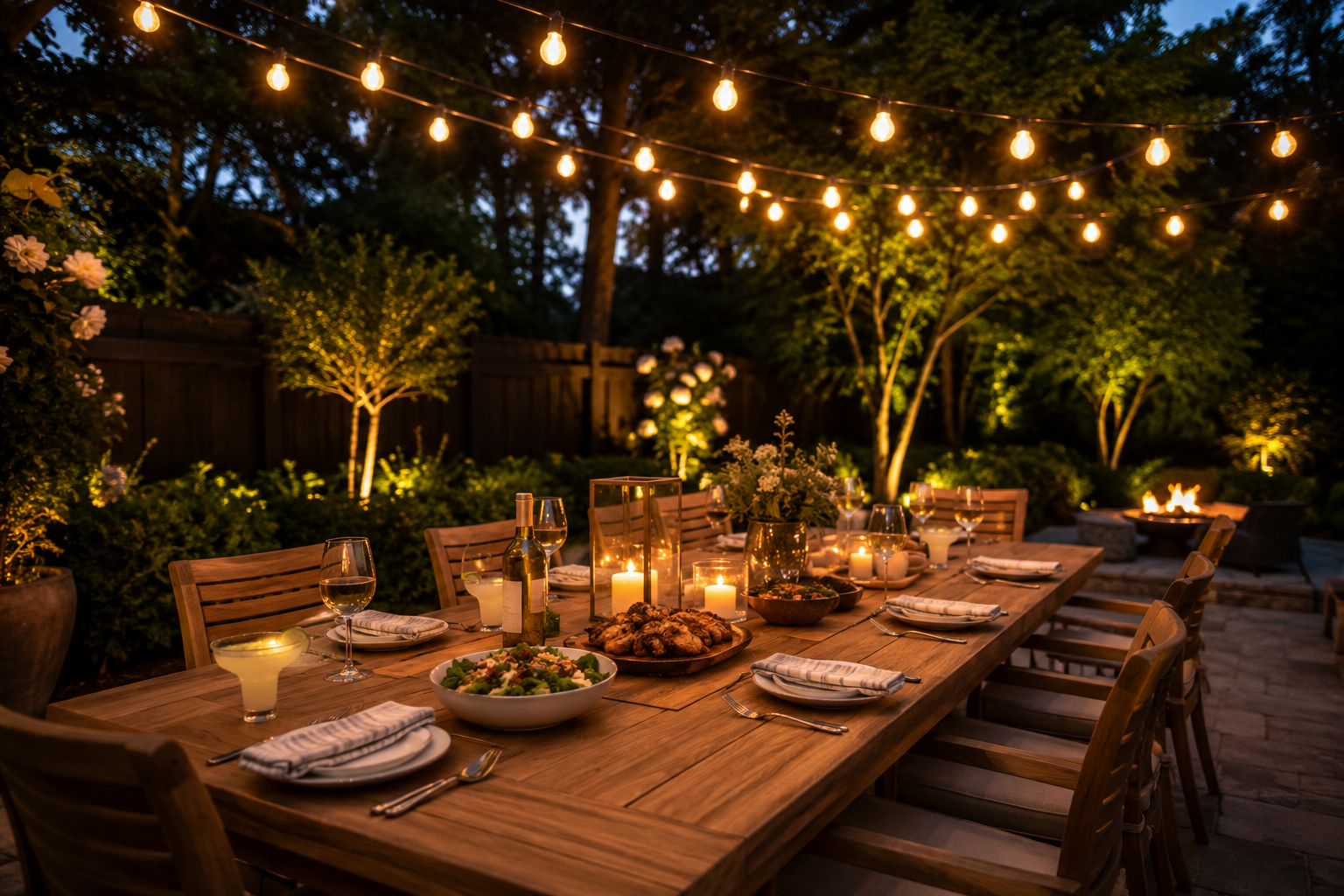
We wait for it. We earn it. And when it finally arrives — really arrives, that first warm week when you can open every window and still be comfortable at ten o’clock at night — the last thing I want to do is spend it indoors arranging centerpieces. Summer calls for something smaller. A table outside, or chairs pulled around a bonfire with a handful of people I love.
My friends and I have arrived, collectively and without much discussion, at the same conclusion: simple is better. A good meal that didn’t take all day. Flowers from wherever, or none at all. Music playing from somewhere. A cocktail that feels like the season. Conversation that goes long because no one is watching the time.
That is a perfect night. Not a produced night — a real one.
The season is too short and too good to spend it executing a vision board. The best memories I have of summer were not planned into existence. They gathered themselves, around a table or a fire, because the conditions were right: good people, good food, and a host who had the sense to get out of the way.
The theme trap
Somewhere in the last decade, summer entertaining absorbed the logic of social media. Every gathering became an opportunity for a concept — a palette, a moment, a story worth telling to people who weren’t there. Hosts began building parties from the outside in: visual first, experience second.
The irony is that this approach, intended to make guests feel celebrated, often has the opposite effect. A heavily themed party signals that the host’s energy went primarily into appearance. Guests can feel it. They are attendees at an installation rather than participants in an evening.
The most gracious hosts your guests have ever known — the ones they speak of for years — were almost certainly not decorators. They were presences. They made people feel at ease, fed them well, and created the conditions for genuine conversation. The table was in service of the people around it, not the other way around.
What restraint actually looks like
Understated entertaining is not sparse entertaining. It is not indifferent entertaining. It requires as much thought as a heavily styled party — the thought is simply directed differently.
Start with the invitation. This is the first communication your guests receive, and it tells them everything about what kind of evening to expect. A well-chosen card — quality paper, the perfect font, a wording that is warm but not casual — sets a tone that no amount of table decoration can manufacture later. An invitation that arrives by post even 10 days in advance, rather than by text or group email, communicates before a word is read that this evening matters. That they matter.
Let the season do the work. June offers something no party planner can source: long golden light, warm air, the particular looseness people carry in summer. A table set outdoors, or near an open window, with simple white linens and whatever is blooming in your garden, is already beautiful. The instinct to add more is almost always wrong.
Edit the table, not just the flowers. A crowded table feels anxious. Leave room. Choose fewer objects and let them breathe. A single good candle is more elegant than seven mismatched votives. A cloth napkin that your guests can actually use is more hospitable than one folded into architecture.
Feed people generously. The food is the party. Not the theme, not the styling — what you set in front of your guests and whether they leave satisfied. A roast chicken that is perfectly done, a salad assembled with care, a dessert that tastes like summer: this is what people remember. The tablecloth color is forgotten by the drive home.
The invitation as commitment
There is one place where deliberateness pays the clearest dividends, and it is the invitation.
We live in an era of frictionless communication. Texts, emails, calendar invites, apps: everything is fast, everything is easy, everything is equally forgettable. A printed invitation is an act of friction — in the best sense. It requires that the host choose a card, write or address an envelope, apply a stamp, walk to a mailbox. This friction is a signal. It tells the recipient: I thought about you specifically. This evening was worth effort.
The wording matters too, and often receives less attention than it deserves. A good invitation is warm but precise. It tells your guests exactly what they are coming to, what to wear, where to arrive, and what time — without over-explaining or hedging. It does not sound like a legal document or a casual text. It sounds like you, at your most gracious.
An invitation to simplify
As summer opens before us, there will be many opportunities to gather: graduation dinners, garden lunches, evenings with old friends that have been too long deferred. Each of these is an opportunity to resist the pull toward more and to choose, instead, the harder and more rewarding path of less.
Set a table you could eat at comfortably. Light a candle. Open something good. Write the invitation by hand, or choose a card that feels like the evening you intend to give.
The party that people remember is never the most produced one. It is the one where they felt, from the moment the invitation arrived, that someone was genuinely glad they were coming.
That gladness is the whole point. Everything else is in service of it.
Looking for invitations that set the right tone before your guests arrive? Browse our summer collection — or reach out for a custom order. We can have pieces in your hands before July.